
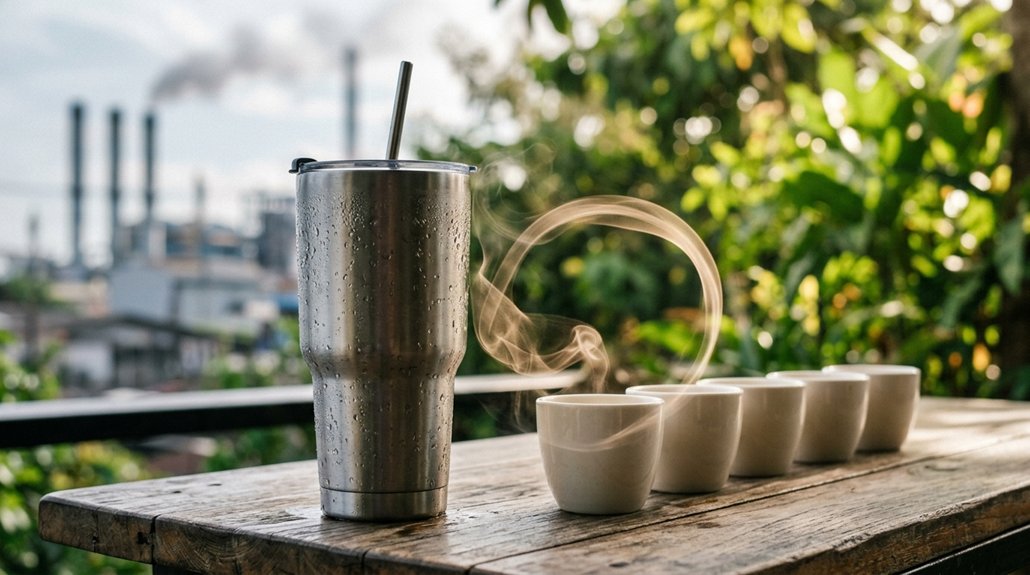
Yes, a stainless-steel tumbler is worth buying if you will actually use it, but only if you plan to use it at least 50 times, and ideally 300 or more. For most buyers, that means a daily driver like the Stanley Quencher H2.0 30 oz, Owala SmoothSip 20 oz, or YETI Rambler 20 oz makes sense. If you know you will use it fewer than 20 times, skip this one and stick with disposables.
The stronger choice is stainless steel, not ceramic. A ceramic mug usually needs hundreds more uses to offset its higher impact, so it is a worse buy for anyone who wants both practicality and a faster carbon break-even. Stainless also wins on durability, insulation, and travel use.
If you care about the break-even number, assume about 50 uses with efficient washing and normal real-world use. If you hand-wash under running water, do small dishwasher loads, or buy a tumbler you rarely carry, use 300 to 350 as the safer target. That makes dishwasher-safe models like the YETI Rambler, Hydro Flask All Around Tumbler, and Owala SmoothSip better value over time.
Buy the tumbler you will actually keep using, not the trendiest one. The Stanley Quencher 40 oz works if you want huge capacity and all-day ice retention, but it is bulky and not fully leakproof, so many people use it less than they expect. For better everyday value, a 20 oz to 30 oz stainless tumbler with cup-holder compatibility and a secure lid usually beats oversized models.
If your goal is the best mix of sustainability and buying value, pick a dishwasher-safe stainless tumbler in the 20 oz to 30 oz range, priced around $25 to $40, and use it daily for years. That is why models like the YETI Rambler 20 oz, Owala SmoothSip Slider, and Hydro Flask 20 oz All Around Tumbler are worth buying. They are easier to live with, easier to clean, and more likely to hit that real break-even point.
Is a Stainless-Steel Tumbler Better Than Disposables?
Yes, a stainless-steel tumbler is usually the better buy than disposables, especially if you drink coffee, tea, or iced drinks more than a few times a week. Plastics can cause chemical leaching into drinks, especially when heated, while stainless steel is non-reactive and helps keep beverages pure. A good 18/8 stainless model like the YETI Rambler 20 oz, Stanley Quencher 30 oz, or Owala SmoothSip costs more up front, usually around $25 to $45, but it lasts for years and performs better every day.
That price makes sense fast if you’d otherwise keep buying plastic cups or flimsy travel mugs. A well-made stainless tumbler can last 5 to 20 years, while cheap plastic cups often crack, stain, hold odors, or lose their lids within months. Stainless is the stronger choice if you want better value instead of constant replacements.
Pay once, then reuse: a quality stainless tumbler lasts years, while cheap plastic cups crack, stain, smell, and lose lids fast.
It also does a better job with temperature control. Vacuum-insulated stainless tumblers from brands like Hydro Flask, YETI, and Simple Modern regularly keep drinks cold for 12 to 24 hours and hot for 4 to 8 hours, depending on size, lid style, and how often you open them. Disposables and thin plastic cups can’t compete if you care about iced coffee staying cold on a commute or tea staying warm through a long morning.
Material quality matters too. Most reputable stainless tumblers use food-grade 18/8 stainless steel and BPA-free lids, and they don’t add the plastic taste that cheaper reusable cups often pick up over time. If you want something worth buying for daily use, skip bargain-bin plastic and stick with trusted brands that publish real specs.
There are a few downsides, but they’re easy to judge before you buy. Stainless tumblers weigh more, usually cost more, and not every model fits a standard car cup holder. The Stanley Quencher 40 oz, for example, carries a lot but feels bulky, while a YETI Rambler 20 oz or Contigo Streeterville 24 oz tends to fit more cars and feels easier to live with daily.
Lid design matters just as much as insulation. If leakproof performance matters, skip straw-first designs and look at models like the Owala SmoothSip Slider or Contigo AUTOSEAL West Loop, which seal better in a bag than a Stanley Quencher-style lid. If you hate hand-washing parts, check dishwasher safety too, because some lids with gaskets and sliders trap odors if you don’t clean them properly.
Tumbler Carbon Footprint: The 1,000-Use Break-Even
Skip the scare line about a stainless tumbler needing 1,000 uses to be worth buying. Reusable tumblers reduce landfill and ocean pollution by replacing disposable cups that are discarded daily. For most people, the real carbon break-even lands closer to 20 to 100 uses, and about 50 uses is the best shorthand.
That makes a well-made stainless tumbler like the Stanley Quencher H2.0 40 oz, Yeti Rambler 20 oz, or Owala Travel Tumbler 40 oz a smart buy if you’ll actually carry it most days.
Stainless steel does have a heavier upfront footprint, roughly 1.5 kg CO2e, and production uses about seven times the fossil fuel of a disposable cup.
But if you use your tumbler regularly, you clear that upfront cost fast.
After that point, every refill beats another disposable cup, and studies suggest total greenhouse-gas emissions can drop by as much as 69 percent.
The 1,000-use number works better as a caution for bad buying habits than as a real shopping rule.
If you keep losing tumblers, replacing trendy colors every season, or buying cheap models that dent, leak, or lose vacuum seal performance early, skip the impulse purchase.
Buy one tumbler you’ll keep using.
A Yeti Rambler 20 oz at around $35 to $38 gives you stronger long-term durability, better dishwasher confidence, and fewer replacement headaches than a bargain no-name cup at $15.
If cup holder fit matters, the Owala 40 oz and Stanley Quencher H2.0 usually make more sense than extra-wide off-brand 40 oz tumblers that wobble or simply don’t fit.
If leak resistance matters more than straw convenience, skip straw-first designs and look harder at models with stronger lid sealing, because real-world carry habits matter more than lab carbon math.
The bottom line is simple.
A reusable stainless tumbler is worth buying if you’ll use it often, wash it, and keep it for years.
If you only reach for it once in a while, don’t expect a big carbon win, and don’t overpay for a premium model just for the sustainability story.
How Quickly Can a Tumbler Offset CO2 (What Affects Timing)?
A laser-engraved stainless tumbler can offset the CO2 from making it fairly quickly, but only if you actually replace a lot of disposable cups or stop buying cheap tumblers that fail after a few months. Since Cermark bridges the CO2 laser to reflective stainless steel, that step is a common reason production speed differs between shops. In real buying terms, a durable 20 oz or 30 oz stainless model like the YETI Rambler, Stanley Quencher, Hydro Flask All Around Tumbler, or RTIC Tumbler is the stronger choice because it lasts longer, engraves well, and gives you a better shot at paying back its footprint through years of use.
What changes the timeline most isn’t the cup itself, but how efficiently the engraving shop produces it. CO2 lasers often slow production on stainless steel because the metal reflects the beam, so many shops use Cermark or a similar marking spray first, then wait about 15 minutes for air drying and another 30 minutes at 300°F for curing.
That extra prep makes custom orders slower and usually more expensive, which matters if you’re choosing between a cheap coated tumbler and a better-value powder-coated stainless model that engraves faster.
If you want a custom tumbler and care about production speed, skip setups that rely on heavy coating steps unless the finish absolutely requires it. Fiber lasers and some blue diode systems can mark or remove paint without the same prep, and that usually means faster turnaround, fewer delays, and lower customization cost on powder-coated models from brands like Polar Camel, RTIC, and Ozark Trail.
Laser settings also affect how fast a tumbler moves from production to actual daily use. Some diode setups can remove paint at up to 18000 mm/min around 65 to 70 percent power, but quality still drops if the operator pushes too fast.
On the other end, detailed passes may slow to 50 to 100 mm/min, and many systems can’t run below 10 percent power, so shops often need extra passes, cleanup, or test runs that cut batch efficiency.
That matters for buyers because a tumbler that engraves cleanly and ships fast is usually worth buying over a fussy finish that looks good in photos but adds cost and delay.
Powder-coated stainless steel in 18/8 construction, especially in common 20 oz and 30 oz sizes, usually gives the best balance of durability, insulation, customization quality, and price.
If you’re deciding between a no-name Amazon tumbler at $12 and a Polar Camel or RTIC around $20 to $30, the branded option is usually the better value because it holds temperature better, resists dents more reliably, and tends to produce cleaner engraved results.
Throughput setup also changes the real offset clock. Shops with rotary attachments, galvo systems, and solid 360 wrap jigs waste less time on alignment errors and retries, which means your tumbler gets finished faster and with less scrap.
That’s one reason custom sellers using consistent blanks like Polar Camel 20 oz, YETI Rambler 20 oz, or Stanley IceFlow models often deliver better results than sellers using random off-brand inventory.
If your goal is to buy one tumbler that lasts, engraves well, and actually earns its environmental keep, buy a proven stainless model and use it constantly.
A 20 oz or 30 oz double-wall vacuum-insulated tumbler from YETI, RTIC, Hydro Flask, or Polar Camel is usually the smarter buy than a trendy low-cost cup with weak insulation, poor lid sealing, and inconsistent finish quality.
45.8 Uses Usually Isn’t Enough: How to Reach the Threshold?
No, 8 uses usually isn’t enough. It’s the same kind of logic behind policy-driven carbon pricing: California’s cap-and-invest program required compliance starting in January 2013. If you care about carbon payoff, a reusable mug only starts to make sense after heavy, consistent use, and for most ceramic mugs that means closer to a few hundred washes than a handful of coffee runs.
A typical ceramic mug starts with a much bigger production footprint than people expect. A handmade pottery mug can land around 1 to 2 kg of CO2 before you pour a drink, and even a simpler ceramic cup often starts near 750 g, so you need far more repeat use to make that upfront cost worth it.
In practical terms, you often need roughly 300 to 350 uses to hit breakeven if you wash it efficiently. That’s why a dishwasher-safe tumbler like the YETI Rambler 20 oz, Stanley Quencher H2.0 30 oz, or Owala Travel Tumbler gives you a stronger case than a fragile ceramic mug, because you’re more likely to use it daily, run it in full dishwasher loads, and keep it in service for years.
If you hand wash small loads, rewash often, or baby a mug that never leaves the cupboard, the payoff gets worse fast. Skip novelty ceramics if you want the better-value low-waste choice, and buy a durable stainless steel tumbler you’ll actually carry, wash, and reuse every day.
Tumbler vs Paper and Plastic Cups: Which Choice Wins and When?
Buy a reusable tumbler if you’ll use it more than a couple dozen times. If you’re planning to compensate with offsets, note that nature-based credits are commonly priced about $7–$24 per tCO2e in 2026. For most people, that means a stainless steel tumbler is the stronger choice and worth buying, while paper cups only make sense for very occasional use or short trips where you can’t wash anything.
If you expect to use your cup fewer than about 20 times total, a disposable cup can still look better on a per-use footprint basis. Even then, paper usually beats plastic because plastic cups create more waste problems, feel flimsier in use, and often face worse end-of-life outcomes.
For actual buying advice, skip cheap thin plastic reusables unless price matters more than durability.
A 20 oz to 30 oz stainless tumbler like the Stanley Quencher H2.0 FlowState, the Yeti Rambler Tumbler, or the Owala SmoothSip works better for daily use because it lasts longer, insulates better, and pays back its higher production footprint through repeated use.
The Stanley Quencher H2.0 in 30 oz costs about $35 to $45 and gives you strong insulation, cup holder compatibility, and a handle many buyers prefer for commuting.
The Yeti Rambler 20 oz usually sells around $35 and stands out for tougher build quality, better lid durability, and dishwasher-safe stainless steel that holds up for years.
If you want the better value pick, the Owala 24 oz tumbler line often lands in the $25 to $35 range and gives you solid leak resistance and easier everyday carry.
That makes it a smarter buy than many no-name Amazon tumblers that look similar but often leak, dent faster, or use weaker lids and straws.
Paper cups still win in some specific cases. In shared offices, clinics, events, or anywhere cleaning gets inconsistent, disposables remain the safer hygiene tradeoff and the lower-hassle choice.
If you must buy disposables, choose paper over plastic. Paper cups still have liners, but they usually create fewer microplastic concerns than clear plastic cups, and they feel like the less bad choice in places with poor recycling access.
For remote trips, camping stops, or one-off travel days, disposables can be the better value and the simpler call.
But for daily coffee, iced water, or commuter use, a stainless tumbler pays off fast and gives you better performance every single day.
Frequently Asked Questions
Does Washing a Tumbler Increase Its Carbon Footprint Enough to Matter?
No, washing a tumbler does not raise its carbon footprint enough to cancel out the benefit of reusing it, so a good tumbler still makes sense if you actually use it. A stainless steel model like the Stanley Quencher H2.0 40 oz, Yeti Rambler 30 oz, or Owala 24 oz costs more up front, but it becomes worth buying once you use it regularly instead of grabbing disposable cups.
If you want the greener and better value choice, buy a tumbler you will keep for years and wash smart with cool or warm water, not long hot cycles every time. Dishwasher-safe options like the Yeti Rambler and Owala FreeSip usually make that easier to stick with, while a bulky tumbler you hate carrying or one that does not fit your cup holder is the one to skip.
How Long Should a Stainless Tumbler Last for Real Climate Benefits?
A good stainless tumbler should last at least 5 to 10 years, and the stronger choice from brands like Yeti, Stanley, Hydro Flask, and Zojirushi often goes longer if you buy 18/8 stainless steel and don’t abuse the lid. If you want real climate benefits, buying one solid 20 oz or 30 oz tumbler and keeping it for years beats replacing cheaper models with weak sliders, thin walls, or peeling finishes.
I would keep using it unless you see the failure points that actually matter, like cracked lids, worn gaskets that kill leak resistance, rust at the seams, or vacuum loss that makes insulation noticeably worse. Cosmetic dents are usually fine, but once a Stanley Quencher stops sealing well in a bag or a budget Amazon tumbler starts sweating on the outside, it is no longer worth trusting.
For buyers deciding what to buy, this is why paying $30 to $45 for a Yeti Rambler 20 oz, Hydro Flask All Around Tumbler, or Stanley AeroLight often gives better value than a $12 no-name cup. The better brands usually offer tougher powder coating, more reliable replacement lids, dishwasher-safe construction, and a longer real-world lifespan, which means fewer replacements and less waste.
Do Different Tumbler Materials Change the Number of Needed Uses?
Yes, tumbler material absolutely changes how many uses you need to justify buying it. Stainless steel models like the Stanley Quencher 40 oz, YETI Rambler 30 oz, and Owala Tumbler 40 oz need more repeat use than a basic plastic cup because steel takes more energy to make, but they usually become the stronger choice if you use them daily for commuting, office drinks, or gym runs.
If you want the fastest break-even point, lightweight plastic tumblers cost less to produce and need fewer uses, but many are easier to stain, crack, or replace. That makes a durable 18/8 stainless steel tumbler worth buying for most people, especially if it fits a car cup holder, survives the dishwasher, and keeps drinks cold for 8 to 12 hours instead of just looking cheap upfront.
Skip heavily coated or low-durability tumblers if you want better long-term value. Powder coating, decorative finishes, and weak interior linings can raise production impact and shorten lifespan, so a simpler, well-built option like a YETI Rambler at around $38 or an Owala at around $30 often gives you the better value than replacing a cheaper tumbler every few months.
Are Travel Lids and Straws Included in a Tumbler’s Carbon Offset?
Yes, usually. If a brand claims a carbon offset or lifecycle footprint for a tumbler, that number should include the lid and straw because buyers use them as part of the full cup system, not as separate extras.
For buying advice, this matters most on tumblers like the Stanley Quencher H2.0 40 oz, Owala 40 oz Tumbler, and Simple Modern Trek 40 oz, since the lid design and straw setup directly affect daily use, cleaning, and how long the parts last. A reusable Tritan straw and a durable BPA-free plastic lid add emissions up front, but they are still worth buying if they hold up for years and do not force you to replace parts every few months.
I would trust brands more when they account for the full package, including stainless steel body, plastic lid, silicone seals, and straw. If a brand talks about sustainability but ignores the accessories you actually use every day, skip this one and look at the details more closely before you buy.
For most shoppers, the smarter move is simple. Choose the tumbler with the stronger lid, easier-to-find replacement parts, and better long-term value, because durability beats a smaller footprint claim that leaves out real-world wear and tear.
What’s the Best Way to Maximize Uses and Avoid Premature Disposal?
The best way to get more life from a tumbler is to buy one with replaceable parts and a durable build, then actually maintain it. Stanley’s Quencher H2.0 in 30 oz and 40 oz, YETI Rambler 30 oz Travel Mug, and Owala 40 oz Travel Tumbler are worth buying because their lids, straws, and seals hold up better than cheap Amazon clones that crack, leak, and end up in the trash early.
Skip thin plastic tumblers with glued parts or no replacement lid support. A stainless steel 18/8 body, dishwasher-safe lid, and easy-to-find replacement gaskets give you better value over time, even if the upfront price is $35 to $45 instead of $15 to $20.
To avoid premature disposal, refill instead of replacing, wash the lid and seal thoroughly, and inspect the gasket before it starts leaking. If you want the longest lifespan, brands with strong spare-parts support like Stanley and YETI are the stronger choice, because swapping a worn straw or seal costs far less than replacing the whole tumbler.
Conclusion
Yes, a reusable tumbler can offset its carbon cost, but only if you actually use it a lot. As a buying rule, skip expensive novelty tumblers you will abandon after a month, and buy a durable daily driver you can realistically use 1,000 times or more.
That makes proven models like the Yeti Rambler 20 oz in 18/8 stainless steel, the Stanley Quencher H2.0 30 oz, or the Owala SmoothSip worth buying over cheap promo cups. A well-made tumbler with a strong lid, cup holder-friendly base, and real dishwasher-safe parts stands a much better chance of becoming your everyday cup.
If you only see yourself using a tumbler a few hundred times, you probably will not come out ahead on CO2, so buy the cheaper, simpler option or skip it entirely. Frequent washing, bulky designs that do not fit your car, and awkward lids all lower the odds that you will keep using it.
The stronger choice is a mid-priced stainless steel tumbler in the $25 to $40 range that you will carry daily for years. Shortlist practical picks like the Yeti Rambler 20 oz, Owala 24 oz Travel Tumbler, and Hydro Flask All Around Travel Tumbler if you want better value, solid insulation, and fewer regrets.