
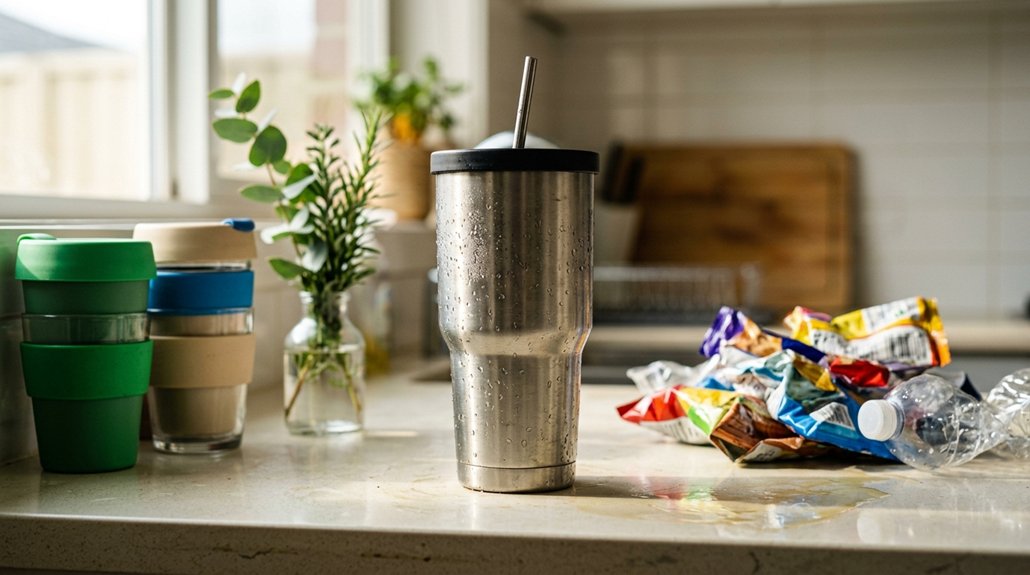
Yes, stainless steel tumblers can be eco friendly, but only if you actually use one for years. If you want the straight buying advice, a well-made 18/8 stainless tumbler like the Stanley Quencher 40 oz, Yeti Rambler 30 oz, or Owala SmoothSip costs more up front but becomes the better value once it replaces a steady stream of plastic or paper cups.
I would not buy a cheap no-name tumbler just for the eco pitch. The stronger choice is a durable model with a solid gasket, replacement lids you can actually order, and a shape that fits your car cup holder, because a tumbler that leaks, dents fast, or gets left at home does not earn back its higher footprint.
The math matters here. A stainless steel tumbler can start around 671 g of greenhouse gases, versus roughly 28 g for paper and 52 g for plastic, so you need about 15 to 50 or more real refills before stainless pulls ahead.
That is why the best eco tumbler is usually the one you keep using, not the one with the loudest green marketing. A Yeti Rambler in kitchen-grade 18/8 stainless, a Hydro Flask All Around Tumbler, or a Stanley IceFlow with proven insulation and easy-to-find replacement parts is worth buying if you want something that lasts daily use, survives drops, and keeps drinks cold long enough to stop you buying disposables on the go.
Are Stainless Steel Tumblers Really Eco-Friendly?
Yes, stainless steel tumblers are eco-friendly enough to be worth buying, but only if you plan to use one for years.
Stainless steel tumblers are eco-friendly—if you’ll actually use them for years, not stash them away.
A solid 18/8 stainless model like the Yeti Rambler 20 oz, Hydro Flask All Around Tumbler 20 oz, or Stanley Quencher H2.0 30 oz beats cheap plastic cups fast if you refill it regularly and keep it in rotation.
If you buy one, use it for a month, then shove it in a cabinet, skip this one and keep your old bottle.
The stronger choice is a durable tumbler you’ll actually carry every day.
Yeti and Hydro Flask usually justify their higher prices, often around $25 to $38 for a 20 oz size, because they resist dents, don’t hold coffee smells, and survive years of drops, dishwashing, and commute abuse.
That long lifespan matters more than marketing claims.
Steel does take more energy to make than plastic, so not every stainless tumbler earns its green reputation right away. Stainless steel doesn’t leach BPA or release microplastics into your drinks.
In practical terms, you need repeated use, roughly 30 to 50 fills, before the better durability starts to outweigh that higher production footprint.
If you already know you lose bottles constantly, a cheaper Tritan bottle may be the better value.
Recycling helps too, and stainless steel has a real advantage here.
It’s fully recyclable, and recycling stainless uses far less energy than producing new metal, up to about 75 percent less.
But that benefit only counts if your local recycling system accepts metal drinkware or if you take it to a scrap metal recycler.
For most buyers, a well-made stainless tumbler is the smarter eco-friendly buy than a low-cost plastic alternative.
Pick a size and shape you’ll actually use, like a cup holder-friendly 20 oz Yeti Rambler for commuting or a 30 oz Stanley Quencher if all-day hydration matters more than leakproof storage.
Buy one good tumbler, use it hard for 5 to 10 years, and it becomes the better value and the greener choice.
What Makes a Stainless Steel Tumbler Low-Impact?
A stainless steel tumbler is low-impact only if you actually reuse it for years, and that makes durable 18/8 or 304 stainless models the ones worth buying. By preventing hundreds of bottles from being discarded over time, a reusable stainless tumbler can cut down on the plastic waste that ends up in landfills and oceans each year. Cheap no-name tumblers often save money upfront but chip, leak, or lose insulation fast, so you replace them sooner and wipe out the environmental upside.
The stronger choice is a well-built tumbler like the Stanley Quencher H2.0 30 oz, YETI Rambler 20 oz, or Hydro Flask All Around Travel Tumbler 32 oz. These use food-grade stainless steel, hold up to daily use, and have the brand track record to stay in service instead of ending up in a drawer after six months.
Vacuum insulation matters because it keeps coffee hot or water cold long enough that you keep reaching for the same cup every day. That’s why a tumbler with solid insulation, dishwasher-safe parts, and easy lid cleaning gives you better value than a cheaper cup that smells, stains, or leaks.
If low impact is your priority, skip painted low-grade steel cups with weak lids and no replacement parts. Buy a model with 304 stainless steel, a reusable straw or well-sealed slider lid, and a size you’ll actually carry, since a 40 oz tumbler that never fits your cup holder gets used less than a 20 oz Rambler or 30 oz Quencher.
Stainless steel also has a real end-of-life advantage because it’s fully recyclable and doesn’t shed microplastics like cracked plastic cups can. Brands that use recycled steel or publish material sourcing details deserve extra credit, but daily usability still matters more, because the greenest tumbler is the one you keep using for years.
How Many Uses Until a Stainless Tumbler Wins?
A stainless tumbler usually starts to make sense after about 15 to 20 refills, so yes, it is worth buying if you will actually use it most days. Thanks to corrosion resistance, stainless steel tumblers resist rust and degradation even with frequent temperature changes. If you want the strongest long-term value, buy a well-made 18/8 stainless model like the Yeti Rambler 20 oz, Hydro Flask All Around Tumbler 20 oz, or Stanley Quencher H2.0 30 oz, not a cheap no-name cup that dents, rusts, or leaks within a year.
For most buyers, the real decision is not whether stainless can beat single-use cups. It can. The smarter question is whether you will carry it often enough, whether it fits your cup holder, and whether the lid design makes daily use easy instead of annoying.
Research cited by Sustainability Victoria puts the break-even point at roughly 15 uses versus single-use plastic. In practical terms, that means a commuter who refills a tumbler for coffee or water every workday can clear that mark in a few weeks, while someone who only uses it for occasional road trips may take months.
A durable tumbler pulls ahead fastest when you buy once and keep using the same cup for years. A Yeti Rambler with kitchen-grade 18/8 stainless steel, a strong powder coat, and dishwasher-safe construction gives you better value than replacing two or three cheaper tumblers that lose insulation or develop lid issues.
Here is the buying reality that matters most
| Use scenario | Likely refill range | Buying takeaway |
|---|---|---|
| Daily commute and office use | 15 to 115 refills | Worth buying, you hit the payoff fast |
| Outdoor trips and travel | 15 to 60 refills | Still worth it, but dents and lid wear matter more |
| Long-term daily ownership | 115 plus refills | Stainless becomes the stronger choice by a wide margin |
If you want a tumbler that actually lasts long enough to justify the higher upfront price, skip ultra-cheap marketplace brands with thin steel and weak sliders. A $35 to $45 Yeti Rambler 20 oz or a $28 to $38 Hydro Flask 20 oz usually gives better price-to-performance than a $15 tumbler that starts leaking or rusting in 12 to 24 months.
Stanley works best if you care more about capacity and straw convenience than compact size. The Quencher H2.0 30 oz and 40 oz offer good insulation and a comfortable handle, but they take up more space and the larger sizes can feel awkward if your main goal is a simple commuter cup.
If you want the safest bet for daily buyers, choose a 20 oz to 30 oz tumbler in 18/8 stainless steel with a dishwasher-safe lid and easy replacement parts. That size range balances portability, cup holder compatibility, and all-day usefulness better than oversized bottles that stay home because they are annoying to carry.
You keep the advantage by using the tumbler consistently and taking care of the lid, gasket, and straw. Clean those parts well, let them dry, and avoid bargain steel that can pit or rust early, because a tumbler only wins if you keep it in service.
Most people should think about it this way. If you will refill it at least a few times a week, a quality stainless tumbler is worth buying. If you know you will forget it in a cabinet after two trips, skip this one and save your money.
With steady use, a good stainless tumbler can last for thousands of fills, even into the several-thousand-use range. That is why the stronger buying advice is simple, buy one good tumbler from a proven brand and use it hard, instead of cycling through cheap replacements.
Stainless vs. Paper vs. Plastic: Life-Cycle Emissions
If you plan to use the same tumbler every day, buy stainless. If you know you’ll forget it, lose it, or keep buying coffee on the go in single-use cups, skip the expensive eco pitch because the numbers only work in stainless steel’s favor after repeated use.
Use the same tumbler daily? Choose stainless—otherwise, the eco case only adds up after repeated use.
A stainless tumbler has a much higher production footprint up front, around 671 g of greenhouse gases versus about 28 g for a paper cup and 52 g for a plastic cup. That only holds if you reach the 1,000 uses benchmark, yet one survey found an average tumbler used 45.8 times before being discarded. In plain English, your YETI Rambler 20 oz, Stanley Quencher 30 oz, or Hydro Flask All Around Tumbler only becomes the cleaner choice if you actually carry it often enough.
Most life-cycle studies put the break-even point at roughly 20 to 115 uses against paper, and a similar range against plastic. That makes stainless worth buying for commuters, office users, and anyone who refills the same cup several times a week, but weaker value for occasional users who care more about convenience than long-term reuse.
Not all stainless tumblers perform equally well, so buying a durable one matters. A $35 to $45 YETI Rambler or Hydro Flask usually makes more sense than a cheap no-name tumbler if the lid seals better, survives drops, and fits your car cup holder, because durability decides whether you’ll hit that reuse number.
Recycled steel improves the case for stainless by a lot. Stainless often includes scrap content, and recycling can cut production energy by up to 75%, while steel stays fully recyclable without losing quality.
If you want the strongest environmental and buying argument, choose a stainless tumbler you’ll realistically use 100 times or more. That usually means a dishwasher-safe model with a reliable lid, practical size, and good daily carry comfort, not just the trendiest bottle on the shelf.
How Do You Choose a Low-Impact Stainless Steel Tumbler?
Choose a tumbler you’ll actually use every day and keep for years, or skip the “eco” marketing and buy the better-made cup.
A low-impact stainless steel tumbler only makes sense if it lasts, seals properly, fits your routine, and doesn’t end up in the back of a cabinet after a month.
The strongest choices are simple 18/8 stainless steel tumblers from brands with a solid track record, like the YETI Rambler 20 oz, Hydro Flask All Around Tumbler 20 oz, and Klean Kanteen Insulated Tumbler 16 oz.
These usually cost about $25 to $38, and they’re worth buying because the body lasts for years and replacement lids are easier to find than on cheap Amazon brands.
Lifespan matters more than almost anything else. For daily coffee drinkers, the environmental break-even is calculated within 2–3 months of switching.
A reusable stainless tumbler carries a noticeable manufacturing footprint, roughly 2.8 kg CO2 and 6.1 kWh per unit, so you need steady use to justify it, about 1,000 uses or roughly a year of daily drinks, not occasional weekend use.
Skip coated mystery-metal cups and ultra-cheap tumblers with no material details.
The stronger choice is food-grade 18/8 stainless steel with clearly listed BPA-free lid parts and silicone gaskets, because those parts hold up better in real use and signal that the brand isn’t hiding the spec sheet.
If you want the lower-impact pick, look for brands that publish material sourcing details or use high recycled steel content, around 80 to 85 percent scrap where stated.
Klean Kanteen has built the best reputation here, and that gives it an edge if sustainability sits high on your list.
Do not ignore the lid.
If the slider breaks, the gasket stretches, or the threads crack, the tumbler’s useful life drops fast, and that wipes out the environmental upside.
For most buyers, the best value sits with a durable 16 oz to 20 oz tumbler that fits a car cup holder, survives dishwasher cycles, and has easy-to-replace lid parts.
That’s why a YETI Rambler or Hydro Flask usually makes more sense than a cheaper no-name tumbler, even if the upfront price feels high.
If you want one clear buying rule, buy the tumbler with the best lid and the clearest material spec, not the one with the loudest sustainability claim.
A cup you use daily for five to ten years beats a “green” tumbler that leaks, chips, or gets replaced in six months.
Frequently Asked Questions
How Are Stainless Tumblers Recycled at End-Of-Life?
Most stainless tumblers are recyclable, and that is worth caring about if you want a bottle that lasts for years and still has value at end-of-life. In practice, you should take a stainless tumbler like a Yeti Rambler 20 oz, Stanley Quencher 30 oz, or Hydro Flask All Around Tumbler to a local recycling center or scrap metal drop-off, not assume curbside pickup will handle it correctly.
Recyclers sort stainless steel with metal recovery equipment, then send it to remelting plants to turn it into new steel products. If you are deciding what to buy, stainless steel is the stronger choice over plastic because it holds up longer, dents less easily in better-built models, and still carries real recycling value at the end.
Do Tumbler Coatings or Lids Reduce Eco Benefits?
Yes, lids and coatings do cut into a tumbler’s eco upside, so if sustainability matters, buy a simple stainless steel tumbler with fewer parts. A powder-coated YETI Rambler 20 oz or Stanley Quencher H2.0 30 oz lasts longer in daily use, which helps, but their plastic lids and mixed materials make recycling harder at the end of life.
The lid causes the bigger problem, not the coating. Tritan, polypropylene, silicone seals, and sliding magnets improve leak resistance and usability, but they also create more parts to separate, and most people do not bother.
If you want the stronger eco pick, choose a tumbler with a durable 18/8 stainless steel body, a basic BPA-free lid, and easy-to-remove seals. That makes models like the Hydro Flask All Around Tumbler 20 oz or Klean Kanteen Rise Tumbler easier to live with, easier to clean, and a better value if you plan to keep one for years.
What’s the Impact of Shipping Heavy Stainless Tumblers?
Heavy stainless tumblers do raise shipping emissions, but that should not decide what you buy unless you are choosing between very similar cups. A 30 oz Stanley Quencher H2.0 in 18/8 stainless steel weighs about 1.4 lb empty, while a lighter 30 oz plastic tumbler ships with less material and often less protective packaging. If low shipping impact matters to you, buy one durable tumbler you will use for years instead of replacing cheaper cups that crack, leak, or lose insulation fast.
For most buyers, the smarter move is to focus on weight plus real daily usability. A heavy tumbler that fits your cup holder, stays leak resistant, and survives the dishwasher gives better long-term value than a lighter cup you stop using after a month. That is why models like the Yeti Rambler 30 oz and Hydro Flask All Around Travel Tumbler usually make more sense than flimsy budget copies, even if they cost more upfront.
Packaging still matters. Brands that ship in tight recycled cardboard with no oversized inserts create less waste than sellers using huge boxes, foam sleeves, and extra wrap to protect painted finishes from dents and scratches. If you want the stronger choice, skip oversized novelty tumblers with fragile coatings and buy a powder-coated 18/8 stainless model from Stanley, Yeti, Owala, or Hydro Flask that balances durability, insulation, and shipping efficiency.
Do Handwashing vs. Dishwasher Use Change Emissions Significantly?
No, handwashing does not cut emissions in any meaningful way for most buyers deciding between dishwasher-safe tumblers. If you own a dishwasher and run full loads, dishwasher-safe bottles like the Stanley Quencher H2.0, Owala FreeSip Stainless Steel, Hydro Flask Wide Mouth, and YETI Rambler usually make more sense because they save time and hold up well to regular machine washing.
The bigger buying factor is durability, not tiny CO2 differences per wash. A dishwasher-safe 18/8 stainless steel tumbler with a powder coat, like a $35 to $45 YETI Rambler or a $38 Owala FreeSip, is worth buying if you want low-maintenance daily use.
Handwashing can help preserve finishes a bit longer on some bottles, especially ones with painted graphics, soft-touch coatings, or insulated lids with more plastic parts. But if you know you will not handwash consistently, skip high-maintenance models and buy a clearly dishwasher-safe tumbler instead.
Partial dishwasher loads waste more water and energy, so that is the one case where handwashing can be the better call. Still, for most people choosing a bottle to use every day, dishwasher safety is a real value feature and often the stronger choice than a handwash-only tumbler that becomes annoying after a week.
How Do Scratches Affect Hygiene and Environmental Performance?
Scratches are a real downside, and if you want the most hygienic, longest-lasting tumbler, buy one with a durable 18/8 stainless steel interior and skip anything that scuffs easily. Deep scratches can trap coffee residue, protein shakes, and oils, which makes cleaning harder and raises the risk of odor and bacterial buildup over time.
This matters more on lower-quality tumblers than on stronger picks like the Yeti Rambler 20 oz, Hydro Flask All Around Tumbler 20 oz, or Stanley Quencher H2.0 30 oz, all of which use kitchen-grade stainless steel and hold up better with normal use. A scratched interior also shortens the tumbler’s useful life, so cheap cups often turn into worse value because you replace them sooner and create more waste.
If you want the stronger choice for daily use, pay more for a well-finished stainless interior that stays smooth after dishwasher cycles, ice, and metal straw contact. That gives you better hygiene, better long-term value, and less chance you will end up replacing a worn tumbler after a year.
Conclusion
Yes, stainless steel tumblers are eco friendly enough to be worth buying, but only if you actually use one for years. A solid 18/8 stainless tumbler like the Yeti Rambler 20 oz, Hydro Flask All Around Tumbler 20 oz, or Stanley Quencher H2.0 30 oz can replace hundreds of disposable cups, and that makes them the stronger choice over paper, plastic, or cheap acrylic mugs.
The catch is simple. If you buy a trendy tumbler, use it for three months, then toss it in a cabinet and buy another, the eco claim falls apart fast.
If you want the best balance of durability, replaceable parts, and long-term value, buy Yeti or Hydro Flask. Yeti lids, straws, and gaskets are easy to replace, the 18/8 stainless body lasts for years, and the powder coat holds up better than many Amazon knockoffs in the $15 to $25 range.
Stanley still makes sense if you want a handled tumbler for all-day hydration, but buy it for daily use, not for the eco badge. The 30 oz and 40 oz Quencher models are less cup-holder friendly than a Yeti Rambler 20 oz or Hydro Flask 20 oz, and the lid design is not truly leakproof, which matters if you commute.
Skip very cheap stainless tumblers with glued-on decorations, non-replaceable plastic lids, or vague material listings. If a brand does not clearly say 18/8 stainless steel, dishwasher safe, BPA-free lid, and replacement part availability, it is usually worse value and more likely to become trash.
The short version is this. Stainless steel tumblers are not automatically green, but a well-made model from a reputable brand is absolutely more eco friendly than cycling through disposable cups or replacing flimsy tumblers every year.