
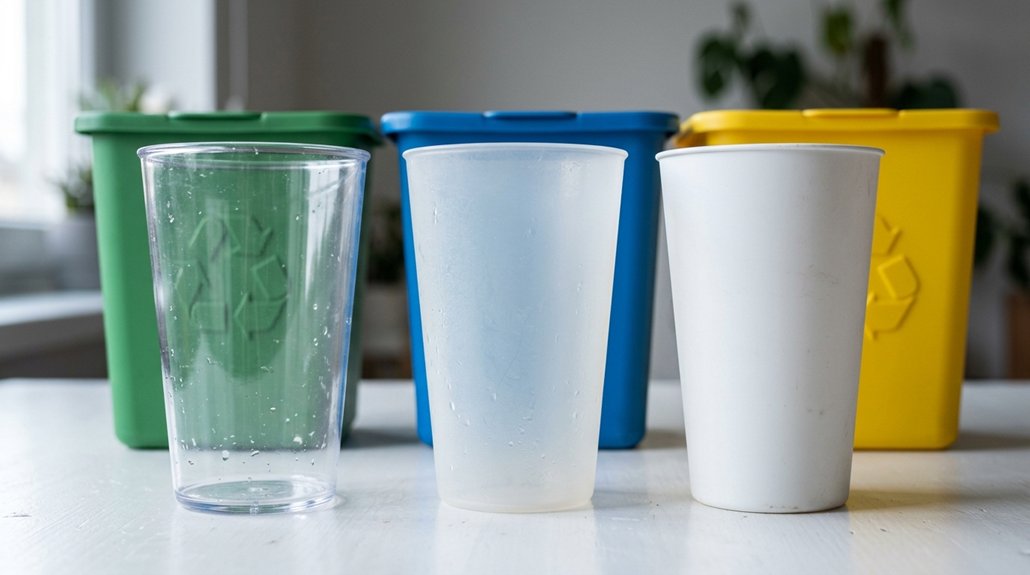
If end-of-life recyclability matters in your buying decision, choose a tumbler made from PET #1 or HDPE #2 and skip mixed-material designs. Those resins give you the best shot at curbside acceptance, while PP #5 still gets rejected often enough that I would not buy it on recyclability claims alone.
That makes simple clear PET tumblers the stronger choice over insulated plastic cups with silicone sleeves, bonded liners, or bundled straws and lids. A cheap 16 oz or 20 oz PET party tumbler from brands like Tervis-style knockoffs or restaurant-supply lines usually recycles more easily than a trendier multi-part reusable cup that looks better on a product page but ends up in the trash.
If you are comparing products, check the resin code on the cup itself, not just the listing title. Skip paper-lined cups, acrylic tumblers without clear recycling info, and sets with lots of mixed parts unless price matters more than disposal, because most recycling programs will not separate lids, valves, and straws for you.
Before you toss any tumbler, empty it, rinse it well, and let it dry fully. Then check your local program by ZIP code, because that final step decides whether even a PET #1 cup is worth buying for recyclability or whether you should pay more for a stainless steel option like the Yeti Rambler 20 oz or Stanley Quencher 30 oz and keep it in service much longer.
Find the Resin Code: PP #5, PET #1, HDPE #2
Check the resin code before you buy or recycle a plastic tumbler. Remember that the resin code is not a guarantee of whether your local curbside program accepts that plastic. If the bottom shows PP #5, PET #1, or HDPE #2, you’re looking at the three codes most likely to matter for everyday tumbler use, and PP #5 is usually the stronger choice for reusable drinkware.
Check the tumbler’s resin code—PP #5, PET #1, or HDPE #2 are the most relevant for everyday use, with PP #5 often strongest.
For buying, I’d pick PP #5 over PET #1 or HDPE #2 for a budget plastic tumbler you plan to reuse often. Polypropylene handles daily use better, shows up in brands like Munchkin and some simple straw tumblers, and usually holds up better to repeated washing than PET. PET #1 works fine for clear, lightweight cups, but I’d skip it for heavy daily reuse if durability matters more than clarity.
For recycling, PET #1 and HDPE #2 usually give you the easiest curbside path. PET #1 often has the strongest recycling market, especially in clear containers, and HDPE #2 also gets broad acceptance and often turns into new household bottles like shampoo or soap containers. PP #5 improves every year, but local curbside programs still vary, so check your city rules before you toss it in the bin.
If you’re comparing a cheap plastic tumbler against a stainless steel option like the Stanley Quencher 40 oz, Owala Tumbler 40 oz, or Yeti Rambler 30 oz, the resin code helps you judge tradeoffs. A PP #5 tumbler can be worth buying if you want low cost and light weight, but it won’t match the insulation, dishwasher confidence, or long-term durability of 18/8 stainless steel.
Always rinse and dry the tumbler before recycling. Food residue and mixed plastics cause sorting problems fast, and that’s the easiest mistake to avoid.
When Are Paper-Lined Cups Accepted? (Check Locally)
Skip paper-lined cups if your goal is easy curbside recycling. In most cities, they belong in the trash because the polyethylene lining sticks to the paper and most sorting lines cannot separate it reliably. Recycling success depends on sending clean and dry items, since contamination makes recovery less likely.
That matters if you are choosing between disposable cups and a reusable tumbler. A reusable stainless steel option like the Yeti Rambler 20 oz Travel Mug, Stanley Quencher H2.0 30 oz, or Owala Travel Tumbler 24 oz gives you a stronger long-term value than buying disposable paper cups that often end up as waste anyway.
| Scenario | Best call | Why |
|---|---|---|
| Dirty paper-lined cup | Trash | Food residue plus plastic lining ruins recovery |
| Clean paper-lined cup | Check local rules | A few programs accept them if their facility can sort them |
| PLA-lined cup | Food waste, only where accepted | Compost rules depend on local commercial compost heat standards |
| Plastic lid or straw | Trash | Mixed materials make recovery unlikely |
| Paper sleeve | Recycling with cardboard | No plastic lining on most sleeves |
If you still buy takeaway coffee often, paper sleeves usually recycle more easily than the cup itself. Lids and straws rarely make the cut, so remove them and trash them instead of assuming the whole set is recyclable.
A better buy for daily use is a dishwasher-safe reusable mug with solid leak resistance and cup-holder fit. The Contigo West Loop 2.0 16 oz usually costs less than a Yeti, seals better for commuting, and beats disposable cups on price after a few weeks of cafe runs.
Some local programs do accept clean paper-lined cups, including parts of Indiana and SWACO service areas, and a few California cities send certain certified compostable cups to food waste collection. Even then, you need to empty the cup, keep it dry, and follow the exact local rules, or you should treat it as trash.
If you are deciding what to buy, the stronger choice is simple. Buy a reusable stainless steel or BPA-free plastic tumbler you will actually carry, and skip paper-lined disposables unless you know your city accepts them.
How to Look Up Your Area’s Cup Recycling Rules
Don’t trust the cup label alone. Also, make sure your cups are empty before recycling. If you care about recycling, check your city or county tool first, because a Starbucks paper cup, a Solo party cup, and a clear PET cold cup often follow completely different rules even if all three look recyclable.
Start with the official recycling website for your address, then match the cup material to what your hauler actually accepts. Clear PETE 1 cold cups usually have the best odds, while lined paper hot cups, black plastic lids, and mixed-material cups get rejected far more often.
If your provider offers a search tool, use the Waste Wizard or its local equivalent before you toss anything in. That matters most for lids, straws, and polypropylene party cups, since many programs accept the bottle but reject the accessories.
In Chicago, check the Blue Cart rules and pickup schedule, because that program sets the real answer for curbside bins. In Lake County, SWALCO lists accepted cup types more clearly, while SWACO specifically excludes party cups, so I’d skip the guesswork and follow the stricter rule.
If you don’t have curbside pickup, look for community drop-off sites like local KNIB centers. If you live in an apartment, ask management which recycling stream your building uses, because many properties only accept recyclables through specific shared bins and private hauling contracts.
Empty, Rinse, and Dry Before You Recycle
Yes, you should always empty, rinse, and fully dry a tumbler before you recycle it. As an approved alternative, you can wipe instead of rinsing with a soiled paper towel or napkin as long as you remove all residue and make sure no liquid remains. If you skip that step, the container has a much better chance of contaminating the recycling stream, which makes it the weaker choice if you actually care whether your Stanley Quencher, Owala Tumbler, or YETI Rambler packaging gets processed correctly.
Start by emptying every bit of liquid or food residue. A little milk, smoothie, coffee creamer, sauce, or tuna water can create odors fast, attract pests, and leave sticky residue on other recyclables.
Then give the container a quick rinse with plain water. You don’t need a deep clean, but you should remove anything sticky or visible, especially from plastic lids, stainless steel tumbler packaging, and drink bottles that held juice or protein shakes.
After rinsing, air-dry the item upside down and shake out any remaining drops before it goes in the bin. A dry container is the stronger choice because it helps reduce contamination and keeps paper or cardboard packaging nearby from getting soaked.
This matters if you buy premium drinkware like a 30 oz Stanley Quencher, a 40 oz Owala FreeSip, or a YETI Rambler with a MagSlider lid, since the packaging often mixes cardboard, plastic film, and molded inserts.
Cardboard is worth recycling, but only if you keep it clean and dry.
If residue still feels sticky after one rinse, do one more quick swish with water and let it fully evaporate. Keep the recycling cart lid closed so rain doesn’t undo the work and turn clean recyclables into trash.
What Recycled Cup Plastics Turn Into Next?
Most disposable cups don’t turn into another cup, so if you care about waste, skip single-use and buy a reusable tumbler instead. Most disposable cups are not recycled, which means they often end up in landfills instead of being turned into new products.
The strongest choice for daily use is a 30 oz Stanley Quencher H2.0 if you want a handle and straw, or a 20 oz YETI Rambler Tumbler if you want a tougher stainless steel cup with simpler cleaning.
If you still want to know what happens after disposal, PET plastic, marked #1, gives you the best odds of becoming something useful again.
In markets that actually accept it, PET cups and lids can turn into new PET bottles, jars, and thermoform clamshell packaging, which makes #1 the most worth buying if you must choose a disposable plastic cup.
HDPE, marked #2, also has decent resale value in recycling streams, and it can become new bottles, composite lumber, pipes, or floor tiles.
That makes #1 and #2 the only realistic plastics to prefer, because local programs actually process them more often.
PP, marked #5, sits in the middle.
Some programs take #5 tubs and lids and remake them into new products, but acceptance still lags behind #1 and #2, so I wouldn’t buy a disposable #5 cup expecting a reliable recycling outcome.
Skip cups made from #3, #4, #6, or #7 if recyclability matters to you.
Polystyrene, usually #6 foam or rigid plastic, often heads straight to landfill, and polyethylene-lined paper cups can contaminate recycling loads, which makes them a poor buy if your goal is lower waste.
The practical buying advice is simple.
If you want the better value, buy a reusable 18/8 stainless steel tumbler with dishwasher-safe parts and a size that fits your cup holder, usually 20 oz to 30 oz with a base under about 3.15 inches.
For better leak resistance and durability, the YETI Rambler 20 oz with MagSlider lid is the stronger choice than most cheap tumblers under $20, though it isn’t fully leakproof and usually costs around $35.
For all-day iced drinks and easier carrying, the Stanley Quencher H2.0 30 oz at about $35 to $45 is worth buying, but only if its large handle and straw design fit how you actually drink.
If you want a cheaper alternative, the Owala 40 oz Tumbler and Simple Modern Trek line usually offer better value than trend-driven dupes because you get solid insulation, cup holder-friendly designs on select sizes, and more color options for less money.
That’s a smarter purchase than betting on a disposable cup ever becoming something useful again.
Frequently Asked Questions
Can I Recycle a Cup Without Its Resin Code Visible?
Usually, no, I would not count on recycling a cup if the resin code is missing. Most curbside programs reject unmarked plastic, so the practical move is to skip the bin unless your local recycler clearly says it accepts that specific cup material.
If you are deciding what to buy, this is a good reason to choose a clearly labeled tumbler from brands like Owala, Stanley, YETI, or Contigo. Their Tritan, polypropylene, and stainless steel cups usually list materials more clearly, which makes end-of-life recycling easier and gives you better value than a cheap unmarked cup that may end up in the trash.
Before you toss it, check the base and inner rim for a small recycling mark, then rinse it and dry it. If you want the safer long-term buy, a stainless steel tumbler like the YETI Rambler 20 oz or Stanley Quencher 30 oz is the stronger choice because it lasts longer, resists odor better, and avoids the recycling guesswork entirely.
Are Lids and Straws From Plastic Tumblers Recyclable Too?
Sometimes, but do not count on it. Most tumbler lids and straws, like the Tritan lids and polypropylene straws you get with a Stanley Quencher 40 oz, Simple Modern Trek 40 oz, or Owala 40 oz tumbler, only get recycled if your local program accepts that exact plastic and shape.
Your best move is to check the resin code on the lid or straw, then follow your city’s rules. If your curbside bin rejects small plastics, skip the bin, rinse and dry the parts, and use a store drop-off or specialty recycler instead, because loose straws and small lid pieces often get sorted out as trash.
What Happens if a Cup Still Has Liquid or Residue?
Yes, leftover liquid or sticky residue can get a reusable cup rejected, so rinse it before you recycle it. Even a high-quality stainless steel tumbler like the Stanley Quencher H2.0 40 oz or Yeti Rambler 30 oz can get pulled out if soda, coffee, or smoothie residue contaminates the sorting line.
If you want a tumbler that is easier to keep clean and worth buying for daily use, pick dishwasher-safe models with simple lids and fewer gasket parts. The Owala Travel Tumbler, Yeti Rambler, and Hydro Flask All Around Travel Tumbler are the stronger choices than cheap no-name plastic cups, because easier cleaning means better hygiene, less odor, and fewer recycling problems later.
Do Mixed-Material Cups Count as Recyclable in Most Areas?
No, mixed-material cups usually do not count as recyclable in most curbside programs, so I would treat them as trash unless your city explicitly accepts them. Paper cups with a polyethylene lining, compostable PLA lining, or glued plastic lids jam sorting lines and contaminate paper bales, which makes them a poor bet if you care about easy disposal.
If recyclability matters, skip disposable paper coffee cups and buy a reusable tumbler instead, it is the stronger choice long term. A 16 oz Stanley AeroLight Transit Mug, a 20 oz YETI Rambler Travel Mug, or a 16 oz Zojirushi SM-SF48 gives you better value because stainless steel bodies last for years, clean up more easily, and avoid the plastic-lined cup problem entirely.
For most buyers, a dishwasher-safe stainless tumbler with a leak-resistant lid is worth buying over any mixed-material cup setup. Check local recycling rules if you want to be certain, but in most areas the practical answer stays the same, skip the recycling bin.
How Can I Verify Local Rules for PP, PET, and HDPE?
Check your city or hauler recycling page first, then call and ask one direct question, do you accept #1 PET, #2 HDPE, and #5 PP in curbside pickup or only at drop-off. That saves time and tells you fast whether your tumbler lid, straw, or bottle body is actually worth sorting.
Treat #1 PET and #2 HDPE as the stronger bets, because most programs accept them more often than #5 PP. Before you toss anything in the bin, make sure it is empty, rinsed clean, and sorted by resin code, because mixed materials and dirty parts get rejected in a hurry.
Conclusion
Yes, some plastic tumblers are recyclable, but only a few are worth buying if end-of-life matters. The safer bet is a polypropylene tumbler marked PP #5 from brands that clearly label the base and offer take-back support, while cheap unmarked acrylic cups are the ones to skip.
Before you toss a worn tumbler, check the resin code on the bottom. PP #5, HDPE #2, and PET #1 give you the best shot, but local recycling rules still decide what gets accepted, so a $6 reuseable cup from Target only helps if your city actually takes that plastic.
Condition matters just as much as the code. If the tumbler looks cracked, deeply scratched, or permanently stained, most programs will reject it, so rinse it, dry it, and only recycle it if it is still structurally intact.
If your area does not accept that plastic, do not wish-cycle it. Brands with clearer material labeling and better end-of-life options are the stronger choice, and they are usually worth buying over no-name tumblers that hide the plastic type and give you no realistic disposal path.